

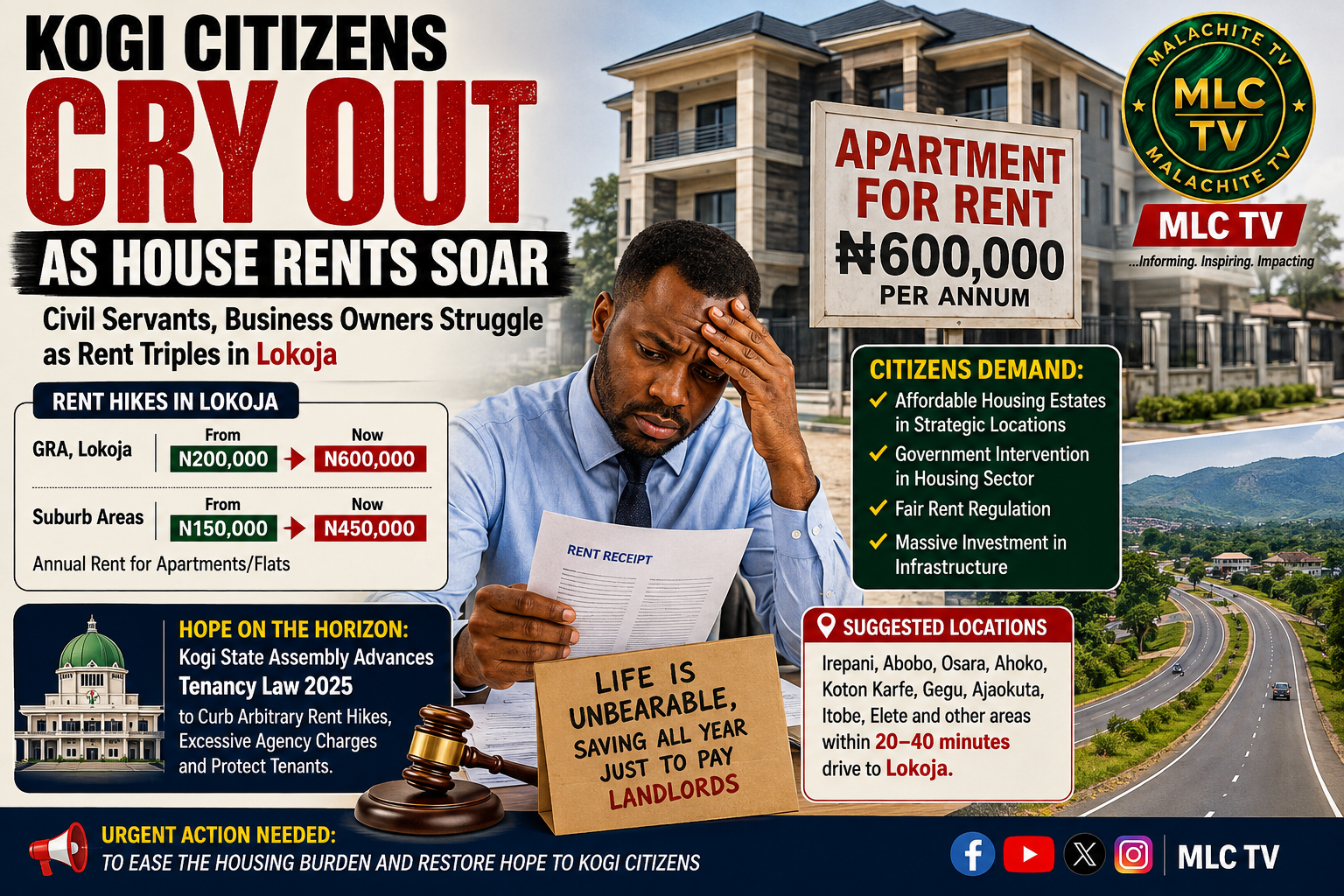
WHEN RENT BECOMES A BURDEN: KOGI CITIZENS CRY OUT AS HOUSING COSTS SOAR
As rents reportedly triple in parts of Lokoja, residents demand affordable housing, while landlords point to rising construction costs
By MLC TV Real Estate Mgt & Investors’ Crew
For many residents of Kogi State, finding a place to live is no longer simply a matter of choosing a comfortable home.
It has become a financial battle.
Across Lokoja and surrounding communities, residents say the cost of renting accommodation has risen sharply, placing enormous pressure on civil servants, small business owners, young families and other low- and middle-income earners.
In parts of Lokoja’s Government Reserved Area, popularly known as GRA, residents report that apartments which previously rented for about N200,000 per annum are now being offered for as much as N600,000.
In some suburban areas, accommodation that previously cost around N150,000 is reportedly going for about N450,000.
For a worker whose salary has not tripled, the mathematics is frightening.
For a small business owner whose income is unpredictable, it can be devastating.
And for a family already struggling with food, transportation, school fees, electricity and healthcare costs, the annual rent bill can consume the savings of an entire year.
“Where Do We Go From Here?”
That is the question increasingly being asked by residents.
Some say they are being forced to choose between remaining in their homes and going into debt.
Others are considering moving farther away from Lokoja’s centre, even if that means spending more time and money commuting to work.
For some families, borrowing to pay rent has become unavoidable.
And when a household is forced to spend a substantial portion of its income on accommodation, the consequences go beyond housing.
It affects feeding.
It affects children’s education.
It affects small businesses.
It affects savings.
It affects the ability of families to plan for the future.
As one resident put it:
«”Life is unbearable due to saving all year just to pay landlords.”»
But Are Landlords Really the Problem?
Not entirely.
This is where the housing debate needs to become more honest and balanced.
While tenants are understandably angry about the sudden increase in rent, some property owners argue that the cost of constructing and maintaining houses has also risen dramatically.
Cement, iron rods, roofing sheets, electrical materials, plumbing materials, doors, windows, tiles, paint and labour are all more expensive than they were years ago.
A landlord who spent millions of naira constructing a property cannot be completely separated from those economic realities.
The question, therefore, should not simply be:
“Why are landlords increasing rent?”
The more important question is:
“What can government do to make affordable housing possible for both landlords and tenants?”
That is where the real conversation begins.
The Housing Crisis Is Bigger Than Rent
The problem is not merely that some landlords are increasing rent.
It is that there are not enough affordable alternatives.
When a worker has only a handful of houses to choose from, the landlord has greater bargaining power.
But when government and private developers provide thousands of decent, affordable housing units across strategic locations, the situation changes.
Tenants have choices.
Landlords face competition.
And the market begins to respond.
This is why the call for government-backed affordable housing deserves serious attention.
Kogi Already Has a Starting Point
Interestingly, Kogi State is not starting from zero.
The state government has previously announced public-private partnership arrangements aimed at delivering affordable housing for civil servants.
More significantly, the state’s 2026 draft budget contains a proposal for the construction of 1,050 housing units across the three senatorial districts, with 50 units envisaged per local government area under the stated programme.
There are also plans listed around housing estates and infrastructure.
The challenge is therefore no longer simply announcing housing projects.
The real challenge is ensuring that such projects reach the people who desperately need affordable accommodation.
Lokoja Needs an Affordable Housing Ring
One practical solution would be to develop a network of affordable housing communities around Lokoja rather than concentrating housing development within the most expensive parts of the capital.
Areas within reasonable commuting distance—including locations towards Irepani, Abobo, Osara, Ahoko, Koton Karfe and Gegu, as suggested by residents—could be considered where land, planning and infrastructure make development viable.
The eastern corridor could equally be examined, including areas around Ajaokuta, Itobe and Elete.
But there is a condition.
Government must not simply build houses and abandon residents to poor roads and expensive transportation.
Affordable housing must come with:
– Good access roads
– Electricity
– Water
– Drainage
– Security
– Schools
– Basic healthcare
– Public transportation
– Markets and commercial facilities
Otherwise, cheap rent could simply be replaced by expensive transportation.
Build Communities, Not Just Houses
This is perhaps the most important lesson.
A modern affordable housing programme should not be about putting blocks of houses on empty land.
It should be about creating communities where people can live, work and raise their families.
If a civil servant can rent an affordable apartment 30 minutes from Lokoja, access reliable transportation, take his children to a nearby school and obtain basic services within the community, the location becomes practical.
Government can therefore use housing development as an opportunity to drive planned expansion of Lokoja and other major towns.
The Private Sector Must Be Part of the Solution
Government cannot—and should not—be expected to build every house.
Public-private partnerships could provide a more sustainable route.
Government can provide land, infrastructure, planning support and incentives, while reputable developers provide financing, construction expertise and property management.
The Kogi State Ministry of Housing and Urban Development itself identifies public-private partnerships, affordable housing, infrastructure development and access to housing finance among its objectives.
That policy direction should now translate into projects that ordinary residents can actually afford.
What About Rent Regulation?
This is another important part of the conversation.
The Kogi State House of Assembly is currently advancing the proposed Kogi State Tenancy Law 2025, which seeks, among other things, to address arbitrary rent increases, regulate estate agents and reduce excessive agency-related charges.
That is significant.
But legislation alone cannot solve a housing shortage.
If government regulates rent without increasing the supply of affordable housing, landlords may simply withdraw properties from the rental market, reduce investment or pass other costs to tenants.
The best tenancy law should therefore protect tenants without destroying the incentive to build houses.
There must be a balance.
Landlords deserve protection from irresponsible tenants, property damage and unlawful occupation.
Tenants, on the other hand, deserve protection from arbitrary rent increases, exploitative charges and unfair eviction practices.
A Five-Point Housing Emergency Plan for Kogi
If the state genuinely wants to ease the pressure on residents, a practical approach could include five immediate priorities.
First: Accelerate affordable housing construction.
The government should set clear annual targets for affordable rental and ownership units and publish progress transparently.
Second: Develop housing corridors around Lokoja.
Government should identify suitable locations within reasonable commuting distance and provide roads, electricity, water and other basic infrastructure.
Third: Expand PPP housing schemes.
Reputable developers should be encouraged to build affordable homes under transparent agreements that prevent the houses from becoming luxury properties beyond the reach of ordinary citizens.
Fourth: Strengthen tenancy regulation.
The proposed tenancy law should provide clear rules on rent increases, tenancy agreements, agency charges, eviction and dispute resolution while protecting legitimate property owners.
Fifth: Create housing finance opportunities.
Civil servants, cooperative societies and low- and middle-income earners should have access to affordable housing loans or rent-to-own schemes, subject to transparent eligibility criteria.
The Civil Servant Should Not Work Only to Pay Rent
There is a deeper issue here.
A society cannot achieve economic stability when workers spend most of their income simply trying to remain housed.
The civil servant who spends almost everything on rent has less money to invest.
The trader who spends a huge percentage of business income on shop rent has less capital to expand.
The young entrepreneur who cannot afford a workspace may never survive long enough to create jobs.
Affordable housing is therefore not merely a social welfare issue.
It is an economic development issue.
The Government Has an Opportunity
The current conversation presents Kogi State with an opportunity.
The Assembly is considering tenancy reforms.
The government has housing projects and PPP initiatives on the table.
The state’s budget also contains significant housing-related proposals.
What residents now need is implementation that can be seen and felt.
They want to know:
Where are the houses?
Who will qualify?
How much will they cost?
Can an ordinary civil servant afford them?
Can a small business owner rent a shop without spending a fortune?
Will the houses come with roads, water and electricity?
And when will ordinary Kogites actually begin moving into them?
These are legitimate questions.
A Call for Action, Not Blame
The housing crisis should not become a war between landlords and tenants.
Landlords are citizens too.
Many have invested their lifetime savings into property.
But tenants are citizens as well.
They need shelter.
They need stability.
They need somewhere their families can call home.
The answer, therefore, is not to demonise property owners.
Nor is it to leave tenants at the mercy of an increasingly expensive housing market.
The answer is to increase housing supply, reduce development barriers, improve infrastructure, provide affordable financing and establish fair tenancy rules.
Kogi has land.
Kogi has people.
Kogi has a growing population and an economy that needs a stable workforce and thriving small businesses.
What is required now is deliberate planning and sustained investment.
Because at the end of the day, a house is not merely a building.
It is where a family sleeps.
It is where children grow.
It is where businesses begin.
It is where dreams are nurtured.
And no citizen should have to spend an entire year’s savings simply to remain under a roof.
Kogi’s housing crisis demands urgent attention—and the time to act is now.